Where it comes from
Star Battle was created by the Dutch puzzle designer Hans Eendebak for the 2003 World Puzzle Championship, held in the Netherlands. It has been a regular in puzzle competitions and puzzle books since, and some books publish it as Two Not Touch.
LinkedIn launched its games in 2024 with Queens among them, and that daily one-star version is how most people meet the puzzle now.
The difference
| Queens | Star Battle | |
|---|---|---|
| Pieces per row, column and region | 1 | Usually 2 (sometimes 1 or 3) |
| Typical size | 7×7 to 9×9 (5×5 to 11×11 in reina) | 10×10 for two-star |
| Pieces may touch | No, not even diagonally | No, not even diagonally |
| Solutions | Exactly one | Exactly one |
The touch rule and the regions are identical. Only the number of pieces per line changes, and that changes a lot. With two stars per row, a row with three open cells in a line is a puzzle in itself, and the squeeze (several regions sharing several rows) becomes the main way through.
Why queens?
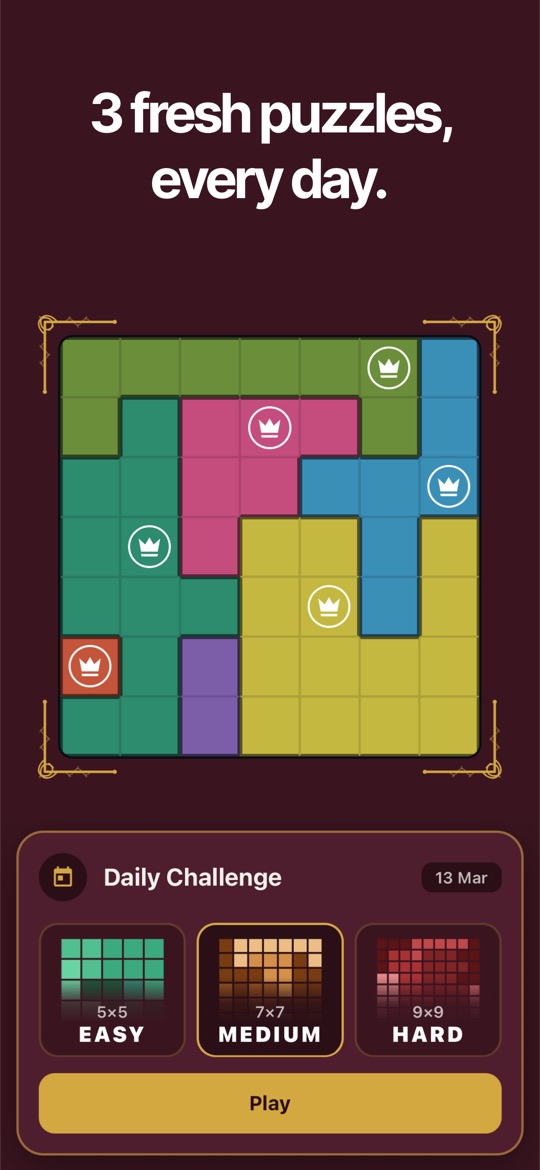
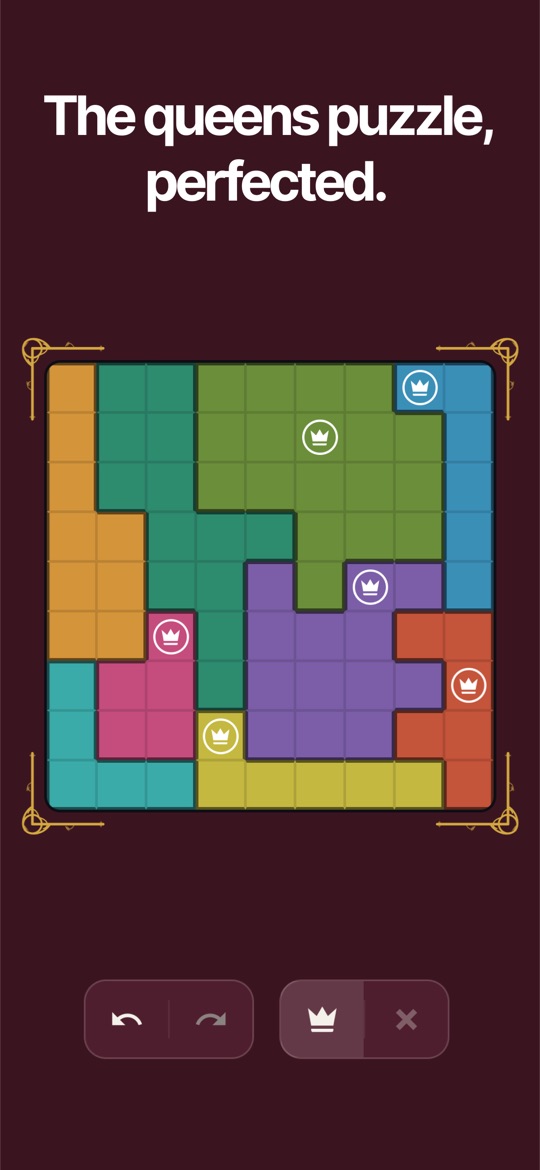
The name nods to the classic eight queens problem from chess: place eight queens on a chessboard so none can attack another. A chess queen attacks along whole diagonals, though, and a Queens puzzle queen only blocks the eight cells around her. The coloured regions are the Star Battle part.
If you like one, try the other
Queens is the better daily habit: quick, clean, a few minutes. Star Battle is the deeper puzzle when you want to sit with something. The techniques carry over, especially the squeeze and blocking cells. For more ideas, see games like Queens.