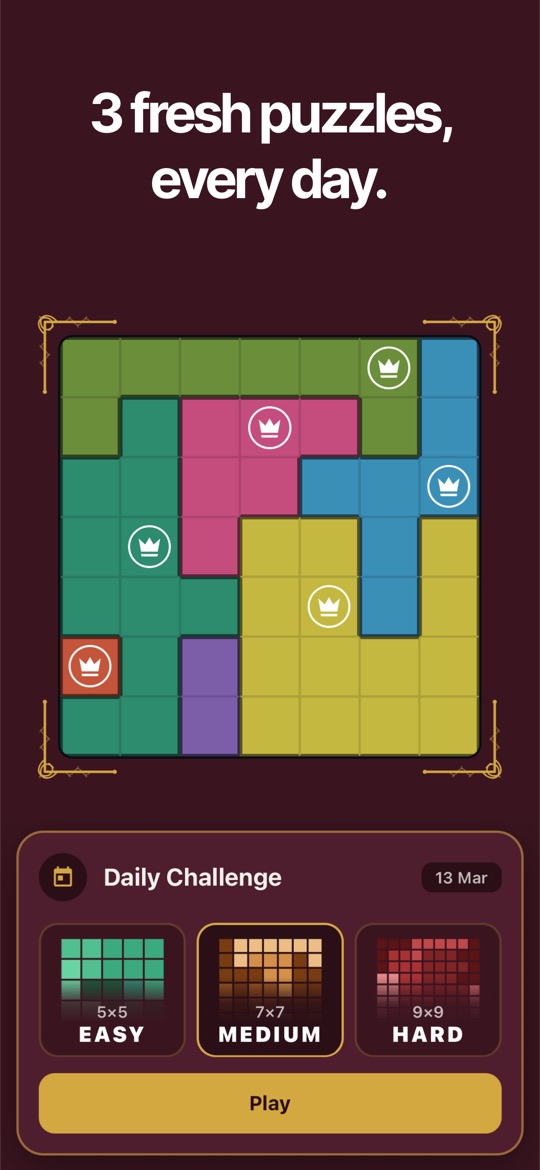
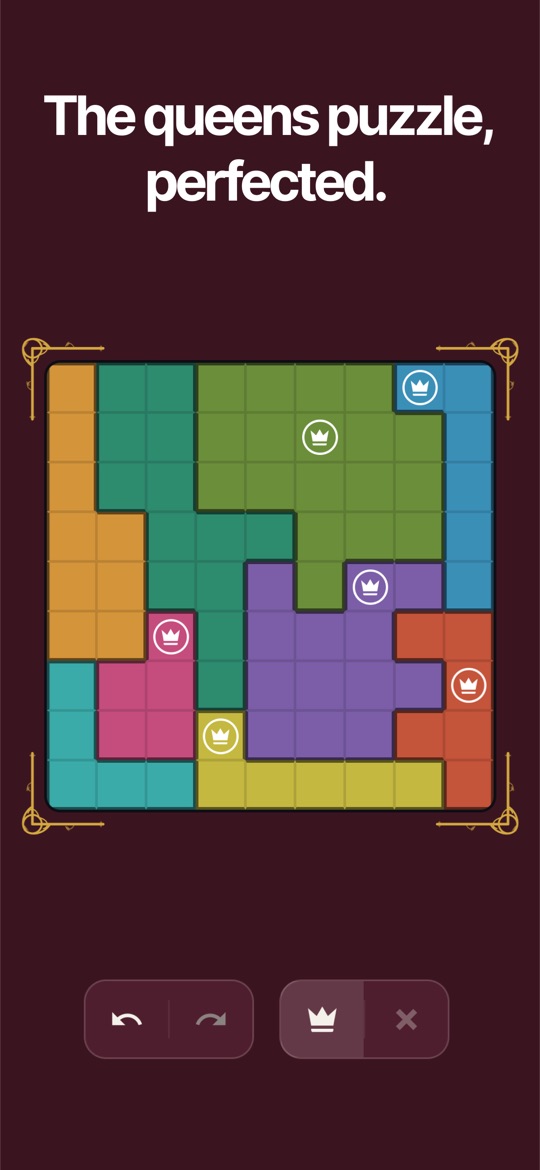
Look at a region and ask which rows it touches. If the answer is one row, then wherever its queen ends up, it is in that row. And since a row only gets one queen, nothing else in that row can have one.
The same works for columns. A tall, thin region that sits in a single column claims that column, and you can cross off every cell of the column that belongs to another region.
How to spot it
Long, straight regions are the obvious ones: a bar along the bottom edge or a strip down one side. But it also happens later in a puzzle, when crosses have trimmed a fat region down until only one row of it is left. Every time you cross off a few cells, glance back at the regions that lost cells and check how many rows and columns they still reach.
Why it matters
This is the most common opening move on LinkedIn Queens. Of the 82 LinkedIn boards we tested, 35 open with a region that fits in one line, more than any other first step.
An example from a real puzzle
On this 5×5 board from the reina app: Look at the emerald region: it fits inside row 1. That makes row 1 its line, and the other 3 cells in row 1 can go.
The usual mistake: Crossing off cells inside the region itself. The region still needs its queen somewhere along that line; it is the other regions’ cells in the line that go.
Practise it
The daily LinkedIn Queens walkthrough labels every step with its technique, so you can see where this one turns up in a real solve. Or play a free puzzle and look for it yourself.